
Outdoor Training vs. Indoor Corporate Training: Which Actually Changes Behaviour?
Every L&D budget eventually faces this decision: book a conference room and a facilitator, or take the team somewhere outdoors for a more immersive program. Both formats have their place, but they don’t produce the same kind of learning and picking the wrong one for your actual goal is a common, expensive mistake.
What Indoor Training Does Well
Indoor, classroom-style corporate training is efficient at transferring structured information. If your goal is to make sure a team understands a new compliance framework, a new software tool, or a specific process change, a well-run indoor session is often the faster, more cost effective option. It’s also easier to schedule, requires less logistical planning and works well for larger groups where the goal is consistent information delivery rather than individual behavioural change.
Indoor training is also generally better suited to purely technical or knowledge-based learning things with a right answer that can be taught, tested and verified. If your team needs to learn a new reporting system, no amount of outdoor challenge is going to teach them the software faster than a focused indoor session with hands-on practice.
Where Indoor Training Genuinely Falls Short
The limitation shows up when the goal isn’t knowledge transfer but behaviour change. You can teach a room full of managers the theory of active listening in an hour. You cannot, in that same hour, actually change whether they listen well under pressure because the room doesn’t create any pressure. There’s no real stakes, no ambiguity, no consequence for getting it wrong. People nod along, agree the concepts make sense and then walk back into the same work patterns the next day, because nothing about the session actually challenged those patterns in the moment.
There’s also a familiarity problem. A conference room looks and feels like every other meeting the team has ever had. That familiarity keeps people in their usual roles the same person dominates the discussion, the same people stay quiet, the same dynamics play out, because nothing about the environment signals “this is different, try something new.”
What Outdoor, Experiential Training Does Differently
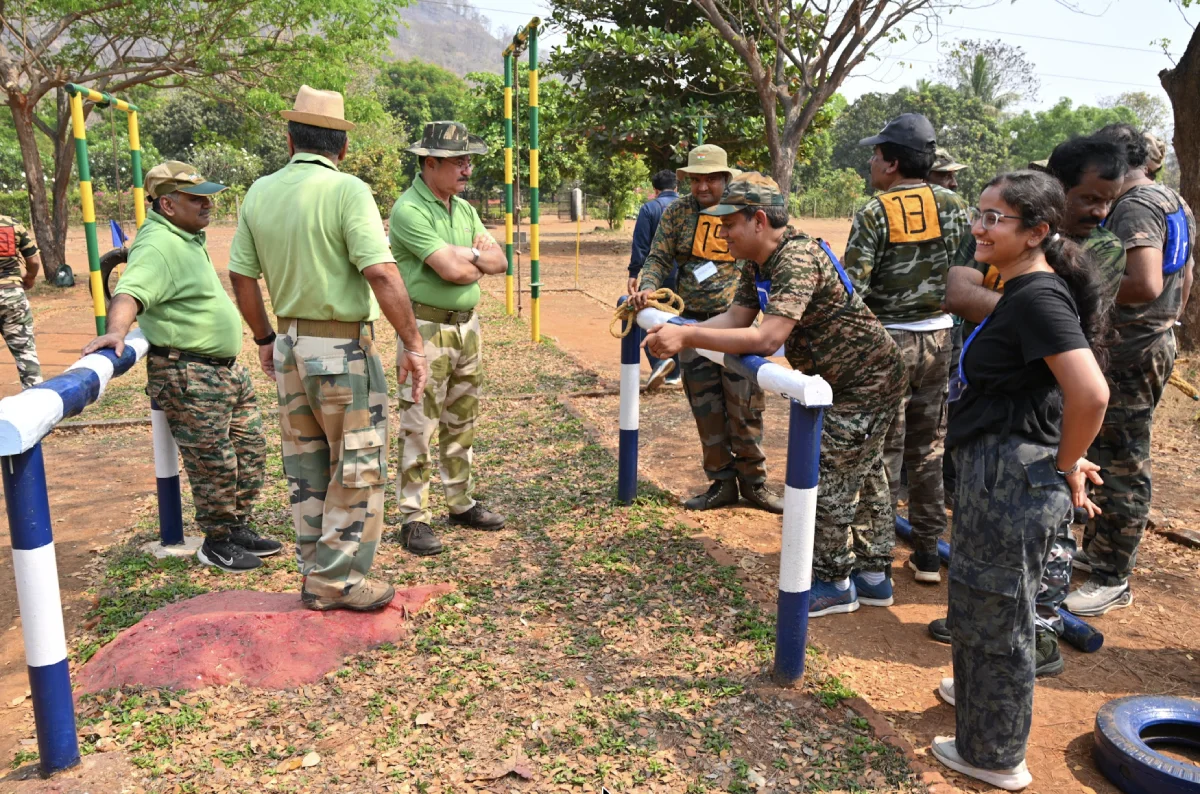
Outdoor training works on a different mechanism entirely. Instead of discussing a concept, it manufactures a real (if controlled) situation where the concept has to be applied immediately, under some degree of genuine pressure, with real consequences within the activity. A team that’s told to “communicate better” in a meeting room can nod and move on. A team navigating a blindfolded obstacle course with unclear instructions cannot fake communicating better either it works, in real time, or the exercise visibly fails.
This is the core advantage: outdoor, experiential formats create genuine, felt consequences for behaviour, which is something a slide deck structurally cannot do. When someone hesitates to make a call during a physical challenge with a countdown running, that hesitation is real and immediately visible to the whole group and far more instructive, in the debrief that follows, than a hypothetical case study about hesitant leadership.
The change in physical environment also matters more than people expect. Taking a team out of the office entirely away from their desks, their usual seating arrangements and their day-to-day status markers tends to loosen ingrained group dynamics. At our Kolad campus, we see this constantly: employees who barely speak up in office meetings often step into leadership roles during outdoor challenges, simply because the environment doesn’t carry the same baggage as the boardroom they’re used to.
The Research behind It
This isn’t just an operational observation it’s backed by how adult learning actually works. Experiential learning research, notably David Kolb’s learning cycle, has consistently shown that people retain dramatically more from active, reflective experience than from passive instruction. Being told a concept and being made to live through a version of it, then reflect on what happened, engage different cognitive processes and the second produces stickier, more transferable learning.
There’s also a stress and cognition angle. Time spent in natural, outdoor environments has been shown to reduce cortisol levels and improve cognitive flexibility compared to indoor, high-stimulation environments like offices. That matters for training specifically because reduced defensiveness and stress tend to make people more receptive to honest feedback during a debrief a genuinely difficult conversation about someone’s leadership blind spots tends to land better outdoors, away from the pressure of the office, than it would in the same building where the problem is happening daily.
When to Choose Which Format
Choose indoor training when: the goal is knowledge transfer, compliance, technical skill building, or process training with a clear right answer and time or budget constraints make an offsite impractical.
Choose outdoor, experiential training when: the goal is behavioural improving communication, building trust, developing leadership, resolving team dysfunction, or creating a shared experience that shifts how a team works together going forward.
Combine both when: you’re running a larger initiative, such as on boarding a new leadership cohort, where technical knowledge (delivered indoors, efficiently) needs to be paired with genuine behavioural development (delivered experientially, outdoors).
A Practical Way to DecideA useful test: ask whether the outcome you want is something you could verify with a quiz. If yes do they know the new policy, can they operate the new system indoor training is probably the right, more efficient tool. If the outcome is something you’d only really know by watching how people behave under pressure do they communicate clearly when stressed, do they trust their teammates, does leadership emerge naturally no quiz will tell you that and no conference room will build it. That’s a job for a genuinely designed outdoor, experiential program with skilled facilitation.
The Cost of Getting This Wrong
The most common mistake we see organisations make is applying indoor logic to a behavioural problem running another workshop, another slide deck, another discussion about “the importance of trust,” when the team’s actual issue requires them to feel something under real conditions, not just hear about it again. If your last three training initiatives for the same recurring team issue haven’t produced lasting change, it’s worth asking honestly whether the format itself, not the content, was the mismatch.

Transforming teams from ordinary to extraordinary, one adventure at a time!
15 Best Team Building Activities for Employees That Actually Work
Search "team building activities" and you'll get a thousand lenticels recycling the same fifteen ideas trust falls, egg drops, human knots with no explanation of why they'd help your specific team, or how to run them so they don't feel forced. This isn't that list....
Team Building vs. Team Bonding: What’s the Real Difference?
HR teams use these two terms interchangeably so often that most people assume they're the same thing planned by different vendors. They're not, and the distinction actually matters when you're deciding how to spend a limited training budget.The Short Version Team...
What Is Corporate Outbound Training? A Complete Guide for HR and L&D Teams
If you've been asked to "look into outbound training" for your organisation, you've probably already noticed that the term gets used loosely sometimes for a picnic with a few games bolted on, sometimes for a genuinely structured leadership intervention. That confusion...

Address:
Camp Office: 263, Sutarwadi, Taluka Roha, Distt Raigad, Maharashtra – 402 304.
Camp Site: Village Kudli, 14 Km Off Kolad, Taluka Roha, Distt Raigad, Maharashtra – 402 308.
Office Hours: 8 am to 8 pm