
15 Best Team Building Activities for Employees That Actually Work
Search “team building activities” and you’ll get a thousand lenticels recycling the same fifteen ideas trust falls, egg drops, human knots with no explanation of why they’d help your specific team, or how to run them so they don’t feel forced. This isn’t that list. Below are activities we actually run at Empower Activity Camps, grouped by what problem they solve, because the honest truth is that “team building” isn’t one thing a team struggling with trust needs a different activity than a team struggling with communication?

Activities for Building Trust
- Blindfolded obstacle navigation one team member is blindfolded and has to complete a physical obstacle relying entirely on verbal instructions from teammates. It sounds simple, but it exposes exactly how clearly (or unclearly) your team communicates instructions and how much patience they have when things go wrong the first time.
- Trust falls (done properly) Overused as a joke, but genuinely effective when scaled up from an individual fall into a team-supported activity where one person has to physically rely on the group. The key is running it with a facilitator who debriefs afterward without that conversation, it’s just a stunt.
- High ropes and rock climbing with belay partners when someone’s safety literally depends on their partner holding the rope correctly trust stops being abstract. This is one of the most effective trust-building activities we run, precisely because the stakes (however controlled) are real.
Activities for Improving Communication
- Resource-restricted building challenges Give a team materials to build something (a raft, a bridge, a tower) but restrict how they can communicate no talking, only written notes, or only one designated “translator.” Teams that rely on one loud voice in meetings quickly discover that voice doesn’t work when the rules change.
- Reverse scavenger hunts Instead of a straightforward hunt, give different team members different pieces of a puzzle or map, forcing them to combine information rather than search independently. These surfaces who naturally shares information and who hoards it.
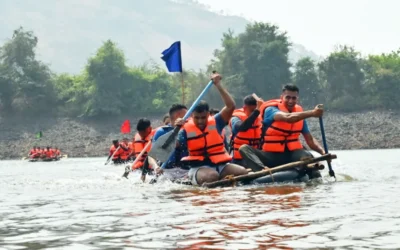
- Raft building and river crossing at our Kolad campus, teams build a raft from provided materials and then have to actually cross water on it. The planning phase alone reveals a huge amount about how a team divides labour and handles disagreement before execution even starts.
Activities for Developing Leadership
7. Rotating leadership challenges A multi-stage physical challenge where the “leader” role rotates every stage and each new leader has to pick up mid-task. This works particularly well for teams where leadership potential is unevenly recognised quieter team members often step up impressively when given the explicit role.
- Crisis simulation exercises A scenario is introduced mid-activity that disrupts the plan (a “resource” is suddenly unavailable; a “team member” is taken out of action). How the group reorganises under pressure tells you far more about real leadership than any planned exercise.
- Command-and-execute drills Borrowed from military training methodology, these involve one person receiving instructions and having to relay and execute them accurately under time pressure. It’s a fast, clear way to expose gaps in delegation and instruction clarity.
Activities for Cross-Departmental Bonding
- Mixed-department relay challenges deliberately mix people who don’t work together day-to-day into physical relay teams. The shared physical effort creates a different kind of rapport than a scheduled “cross-functional lunch” ever manages to.
- Shared cooking or campfire cooking challenges there’s something genuinely disarming about cooking together outdoors. Hierarchies flatten naturally when everyone’s chopping vegetables or tending a fire and conversations happen that wouldn’t happen in a conference room.
Activities for Decision-Making under Pressure
- Timed problem-solving courses Multi-stage courses where each stage has to be solved before the next unlocks, under a countdown. Time pressure is a great equaliser it forces teams to stop over-deliberating and start acting, then reflect afterward on what they’d have done differently with more time.
- Resource allocation simulations Teams are given limited resources (rope, planks, time) across multiple competing objectives and have to prioritise. This maps closely onto real budget and resourcing decisions back at the office, which makes the debrief conversation land especially well.
Activities for Reflection and Reset
- Guided nature walks with structured reflection prompts not every activity needs to be high-intensity. A quieter walk through Kolad’s landscape, paired with specific reflection questions from a facilitator, gives team’s space to process everything they’ve experienced in the more physical sessions.
- End-of-day group debrief circles this isn’t technically an “activity” in the traditional sense, but it’s the single most important part of any team building day. Sitting the whole group down and letting a trained facilitator draw connections between the day’s challenges and real workplace patterns is what turns a fun day into something that actually changes behaviour.
Why the List Alone Won’t Get You Results
Here’s the part most articles like this skip: running any of the above activities without a clear objective and a skilled facilitator will still produce a fun day but it won’t produce change. We’ve watched teams do a raft-building challenge purely as entertainment and walk away having learned nothing about how they actually work together, simply because no one connected the dots afterward. That’s why, at Empower, we never hand a company a fixed menu of activities. Before we design a program, we ask what’s actually going on is this team newly merged, are they struggling with a specific leader’s delegation style and is there unspoken tension after a tough quarter? The activities above are tools and like any tool, the right one depends entirely on the job.
A Practical Starting Point
If you’re planning your first team building program and aren’t sure where to start, pick the category above that matches your team’s biggest current friction point trust, communication, leadership, cross-team collaboration, or decision-making and build the day around two or three activities from that category rather than trying to cover everything at once. A focused half-day that actually addresses one real issue beats a scattershot full day of unrelated games almost every time. And whatever activities you choose, don’t skip the debrief. It’s the least “fun” part of the day and the part that actually pays for itself.

Transforming teams from ordinary to extraordinary, one adventure at a time!
How to Improve Employee Engagement beyond Pizza Parties and Perks
Most employee engagement strategies fail for the same reason: they treat engagement as something you can buy with snacks, swag, and the occasional office party. Free lunch on Fridays is nice. It is not a strategy. If your organisation is seeing disengagement quiet...

Office Outing Places in Pune: Empower Activity Kolad
If you’ve typed “office outing places in Pune” or “outbound training near me” into a search bar recently, you’ve probably noticed the results split into two very different categories — resorts built for leisure, and a much smaller list of places actually built for corporate training. Empower Activity Kolad sits firmly in the second category, and this guide explains exactly why, what experiential learning camps actually involve, and how Empower compares against the other top corporate training companies in Pune.
Team Building vs. Team Bonding: What’s the Real Difference?
HR teams use these two terms interchangeably so often that most people assume they're the same thing planned by different vendors. They're not, and the distinction actually matters when you're deciding how to spend a limited training budget.The Short Version Team...

Address:
Camp Office: 263, Sutarwadi, Taluka Roha, Distt Raigad, Maharashtra – 402 304.
Camp Site: Village Kudli, 14 Km Off Kolad, Taluka Roha, Distt Raigad, Maharashtra – 402 308.
Office Hours: 8 am to 8 pm