
Why Nature-Based Leadership Training Produces Better Leaders
There’s a reason so many of the most respected leadership development traditions military officer training, outdoor education programs, wilderness leadership courses take place outdoors rather than in conference rooms. It’s not tradition for tradition’s sake. Natural, outdoor environments create specific psychological and cognitive conditions that indoor training simply cannot replicate, and those conditions turn out to matter enormously for how leadership actually develops.

The Cognitive Case: Why Nature Changes How People Think
A substantial body of research on environmental psychology has found that time spent in natural settings measurably reduces cortisol levels and mental fatigue compared to time spent in built, urban environments. This isn’t a minor wellness benefit it has a direct impact on leadership development specifically, because clear thinking, patience, and openness to feedback are all cognitively expensive resources that degrade under chronic stress.
A leader practicing decision-making in a stressed, depleted cognitive state which describes most people most of the time in a busy office is practicing a compromised version of the skill. The same person, in a natural setting where stress markers are measurably lower, has more genuine cognitive bandwidth available for the harder parts of leadership: staying calm under pressure, listening rather than reacting, weighing a decision rather than rushing it.
Nature Removes the Usual Status Signals
Offices are full of subtle hierarchy cues who has the corner office, who sits where in meetings, who speaks first by unspoken convention. These cues shape leadership dynamics whether anyone intends them to or not, often reinforcing existing power structures rather than revealing genuine leadership capability.
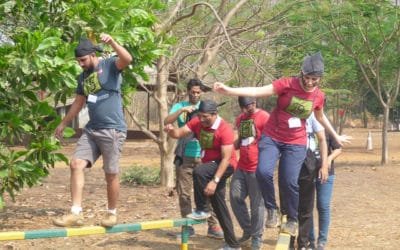
A natural, outdoor setting strips most of this away. Nobody has seniority on a rope course. The usual visual and spatial hierarchy cues simply don’t exist in the same way, which tends to level the field and let leadership emerge based on how people actually respond to the challenge in front of them, not their job title. This is one of the most consistent things we observe running leadership programs at our Kolad campus quieter employees, who rarely assert themselves in office meetings, frequently step forward and lead effectively once the usual office context disappears.
Real Consequences Create Real Learning
Indoor leadership training, however well designed, struggles to create genuine stakes. A case study discussion about a leadership failure carries no real consequence for the person discussing it it’s someone else’s mistake, safely at a distance. Outdoor, nature-based challenges create actual, felt consequences within a controlled environment: a wrong decision genuinely slows the group down, a hesitant call genuinely costs time on a countdown, a breakdown in communication genuinely causes the team to fail a challenge in real time.
These consequences are contained and safe, but they’re not hypothetical, and that distinction matters enormously for how deeply the lesson registers. A leader who freezes during a real (if low-stakes) crisis on a challenge course learns something about their own instincts that no amount of discussing “decision paralysis” as a concept would teach them nearly as effectively.
Why Physical Challenge Specifically Matters for Leadership
There’s something specific about physical, outdoor challenges navigating difficult terrain, building something with limited materials, coordinating a team through an obstacle that indoor problem-solving exercises don’t replicate. Physical challenges are harder to over-intellectualise. A team can debate strategy endlessly in a conference room; on a physical course with a countdown running, at some point someone has to act, and that action reveals leadership instinct in a way that pure discussion doesn’t.
This is part of why military-style leadership training has relied on physical, outdoor challenges for generations not because physical fitness itself is the point, but because physical challenge under time pressure is one of the most reliable ways to surface how someone actually behaves when a decision genuinely has to be made now, not eventually.
The Role of Facilitators with Genuine Command Experience
Nature-based leadership training is significantly more effective when the facilitator has real experience leading people through consequential situations, rather than purely academic knowledge of leadership theory. At Empower, our facilitators are senior Army veterans people who’ve had to make fast, high-stakes decisions with incomplete information, often with real consequences riding on the outcome. That background shapes what they notice during a leadership challenge and the specificity of the feedback they can give.
A facilitator without that lived experience can guide a group through a framework. A facilitator who’s actually commanded people under pressure can look at the exact moment a participant hesitated to give a clear instruction and connect it, with real credibility, to what that hesitation costs in a genuine crisis because they’ve seen it happen, and seen the consequences, outside of a training context entirely.
What This Looks Like in Practice
At our 50-acre campus in Kolad, on the Mumbai-Goa highway, leadership programs are built specifically around this principle. Participants aren’t handed leadership theory and asked to discuss it they’re placed into physical, time-pressured challenges where leadership has to happen, in real time, with a facilitator observing closely and debriefing specifically afterward. The natural setting itself away from the noise and status cues of the office, 2.5 hours from Mumbai and Pune but far enough to feel like genuine distance is part of the design, not incidental scenery.
Who Benefits Most From This Approach
Nature-based, experiential leadership training tends to produce the clearest results for first-time managers still forming their leadership identity, high-potential employees being prepared for future leadership roles, and existing leadership teams navigating organisational change where old habits may no longer serve the new context. In all three cases, the value comes from the same mechanism: real, felt experience under genuine (if controlled) pressure, in an environment that removes the usual distractions and hierarchy cues of the office, followed by specific, credible feedback from a facilitator who understands what good leadership under pressure actually looks like from first-hand experience.
The Underlying Insight
Leadership isn’t primarily a knowledge problem most managers already know, intellectually, what good leadership looks like. It’s a practiced, pressure-tested instinct problem, and instincts are shaped far more by lived experience than by information. Nature-based leadership training works because it manufactures that lived experience deliberately, in a setting specifically designed to strip away the usual distractions and status games of office life, and hands the resulting insight to a facilitator equipped to make sense of it credibly. That combination genuine environment, genuine stakes, genuine facilitation experience is difficult to replicate indoors, no matter how well-designed the workshop.

Transforming teams from ordinary to extraordinary, one adventure at a time!
7 Signs Your Team Urgently Needs Outbound Training
Most organisations wait too long to invest in outbound training, usually because the signs of a struggling team get explained away as normal workplace friction "everyone's just busy," "it's a tough quarter," "that's just how meetings go here." Below are seven patterns...

How Experiential Learning Boosts Workplace Productivity
Productivity problems rarely come down to a lack of effort. Most teams that are underperforming aren't lazy they're stuck in patterns of poor communication, unclear decision-making, or low trust that quietly drain hours every week. Experiential learning addresses...
How to Improve Employee Engagement beyond Pizza Parties and Perks
Most employee engagement strategies fail for the same reason: they treat engagement as something you can buy with snacks, swag, and the occasional office party. Free lunch on Fridays is nice. It is not a strategy. If your organisation is seeing disengagement quiet...

Address:
Camp Office: 263, Sutarwadi, Taluka Roha, Distt Raigad, Maharashtra – 402 304.
Camp Site: Village Kudli, 14 Km Off Kolad, Taluka Roha, Distt Raigad, Maharashtra – 402 308.
Office Hours: 8 am to 8 pm