
How Experiential Learning Boosts Workplace Productivity
Productivity problems rarely come down to a lack of effort. Most teams that are underperforming aren’t lazy they’re stuck in patterns of poor communication, unclear decision-making, or low trust that quietly drain hours every week. Experiential learning addresses productivity from an unusual angle: instead of teaching time management or efficiency techniques, it fixes the underlying team dynamics that were slowing everything down in the first place.
The Real Productivity Killers Most Training Ignores
Ask most managers why their team’s productivity has stalled and you’ll get answers like “we need better processes” or “people need to manage their time better.” Dig a little deeper, and the actual causes are usually more human: decisions get stuck because no one’s clear who has authority to make the call, meetings run long because communication is unclear, rework happens because assumptions weren’t checked, and momentum stalls because trust is low enough that people double-check each other’s work instead of moving forward. None of these get fixed by a time-management workshop. They get fixed by teams actually practicing clearer communication, faster decision-making, and higher trust which is precisely what well-designed experiential learning is built to do.
Why “Learning by Doing” Outperforms Passive Training for Productivity Specifically
Research on adult learning retention consistently shows that people remember and apply far more from active experience than from passive instruction commonly cited figures suggest people retain a small fraction of what they simply hear or read, compared to what they actually do and then reflect on. For productivity specifically, this matters because efficient teamwork isn’t a knowledge problem, it’s a practiced-skill problem. Knowing that clear communication improves speed doesn’t make someone communicate clearly under pressure. Practicing it, in a real (if controlled) high-pressure situation, and getting immediate feedback on what worked and didn’t, do.
This is the core mechanism behind experiential learning’s impact on productivity: it doesn’t teach teams about efficiency, it puts them in situations where efficiency either happens or visibly doesn’t, and then helps them understand why.
How This Plays Out in a Real Program
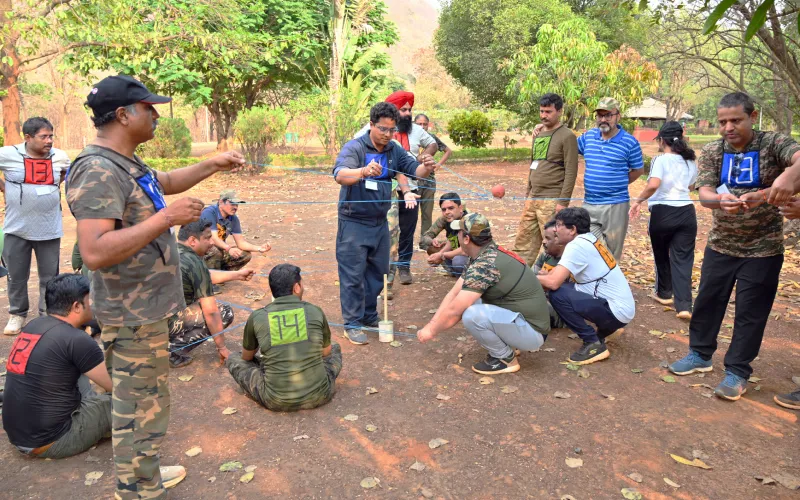
At Empower Activity Camps, we see this pattern play out consistently across the programs we run for teams at our Kolad campus. A team given a time-boxed physical challenge build a structure, cross an obstacle, solve a multi-stage puzzle under a countdown, discovers in real time exactly where their process breaks down. Maybe they spend too long deliberating before acting. Maybe one person’s unclear instructions cause repeated mistakes. Maybe nobody claims ownership of the final decision, so the group circles the same debate without resolution.
These are the exact same patterns showing up in their workplace a stalled project, a missed deadline, an overly long approval process just compressed into an hour instead of stretched across a quarter. Because the consequence is immediate and visible (the challenge fails, the clock runs out), the lesson lands with a clarity that a retrospective meeting about last quarter’s missed deadline never quite achieves.
The Link between Reduced Stress and Increased Output
There’s also a less obvious productivity lever: stress reduction. Sustained workplace stress measurably degrades cognitive performance focus, memory, creative problem-solving all suffer under chronic pressure. Time spent in a genuinely different, natural environment has been shown to lower stress markers and restore some of that cognitive capacity. Teams that return from a well-run outdoor program don’t just have better teamwork habits; they often report simply thinking more clearly for a period afterward, which shows up in output.
This is part of why organisations that treat outbound and experiential training as a periodic reset, not a one-time event, tend to see more durable productivity gains than those chasing efficiency purely through process changes and software tools.
Trust as a Direct Productivity Multiplier
Low-trust teams are measurably slower, even when every individual is competent. Work gets double-checked unnecessarily, information gets withheld out of caution, decisions get escalated that shouldn’t need to be. Experiential activities that require genuine reliance on teammates belaying a partner on a climb, relying on someone else’s instructions during a blindfolded task build trust faster than almost any other intervention, because trust built through actual shared risk and reliance tends to be more durable than trust built through conversation alone.
Teams that trust each other move faster by default. Fewer approvals feel necessary, fewer things get re-verified, fewer decisions get escalated up the chain out of caution. That speed compounds over weeks and months in ways that are hard to attribute to any single training day, but that show up clearly when you compare high-trust and low-trust teams’ actual delivery timelines.
What a Productivity-Focused Experiential Program
- Should Include Not every outdoor or experiential program is designed with productivity specifically in mind, so if that’s your primary goal, look for a few specific elements:
- Time-pressured challenges, since urgency is what exposes real decision-making bottlenecks, not leisurely activities with no deadline
- Clear connection to real workplace scenarios during the debrief, ideally with a facilitator who asks the team to map what just happened directly onto specific recurring issues at work
- Follow-up accountability, since insight from a single day fades without reinforcement the best programs end with participants naming specific changes they’ll make, ideally tracked by a manager afterward
- Measuring the Productivity Impact Because productivity gains from experiential learning are behavioural rather than purely knowledge-based, they’re best measured over weeks, not immediately after the program. Useful indicators include time-to-decision on team projects, frequency of rework or errors caused by miscommunication, meeting length and resolution rates, and simple qualitative check-ins with the team about whether collaboration feels faster or slower than before.
The Underlying Principle
Productivity is ultimately a function of how well people work together, not just how hard any one person works. Experiential learning targets that specifically it doesn’t teach efficiency as a concept, it creates the conditions where a team has to practice being efficient together, under real pressure, and then helps them understand exactly what changed when it worked. That’s a fundamentally different, and often more durable, path to better output than another process overhaul or productivity app.

Transforming teams from ordinary to extraordinary, one adventure at a time!

Invest In Skills For Increase In Profitability
“You don't build a business, you build people, then people build the business.” Well-rounded, highly-developed soft skills can be invaluable to business success but what are soft skills and why are they important? Soft skills are an essential part of finding,...

Army Doctrines For Corporate Training
Military training techniques are often associated with war, although business leaders can definitely learn several useful lessons from them. Discipline, high standards, leadership and execution of task are just a few of the qualities that comprise a strong and...

WALK, PLAY, MOVE: Importance Of Physical Fitness
Majority of the world population is in the working-age group. This group spends most of their waking hours at workplaces. Their job requirements are forcing them to adopt sedentary lifestyles, working behind computer screens, sitting at desks, staying in sitting...

Address:
Camp Office: 263, Sutarwadi, Taluka Roha, Distt Raigad, Maharashtra – 402 304.
Camp Site: Village Kudli, 14 Km Off Kolad, Taluka Roha, Distt Raigad, Maharashtra – 402 308.
Office Hours: 8 am to 8 pm