
Embracing Uncertainty: How Experiential Learning Develops Team Agility
In a world characterized by volatility, uncertainty, complexity, and ambiguity (VUCA), organizations are continuously pushed to adapt. Agility—the ability to respond quickly and effectively to change—has become one of the key competencies for sustainable business success. Data from a McKinsey & Company report (2023) suggests that organizations prioritizing agility are 70% more likely than their less agile counterparts to rank in the top quartile of financial performance. Experiential learning, a hands-on and immersive approach to development, has emerged as one of the most effective ways to foster agility within teams.
What is Experiential Learning?
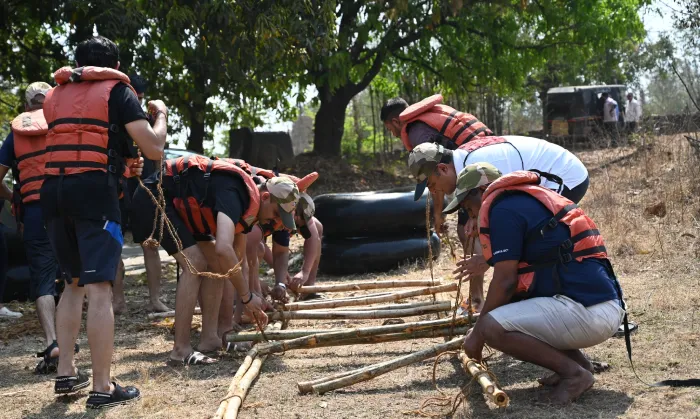
Experiential learning, a concept pioneered by educational theorist David Kolb, is based on the principle that knowledge is created through the transformation of experience. Unlike traditional classroom learning that emphasizes theory, experiential learning promotes active engagement, reflection, and real-world application. Teams participate in simulations, outdoor challenges, and problem-solving activities that replicate workplace complexities—helping them build resilience, adaptability, and collaboration.
The Relationship Between Experiential Learning and Agility
- Developing Adaptive Mindsets: Experiential learning pushes participants out of their comfort zones. Activities like leadership simulations or outdoor challenges expose individuals to unpredictable environments, demanding quick thinking and flexibility. Research in the Journal of Organizational Behavior (2021) found that experiential learning enhances psychological flexibility—an essential quality for agile organizations.
- Fostering Collaboration Under Pressure: Agility is not just about speed; it’s also about synergy. Experiential activities require participants to rely on each other’s strengths, communicate effectively, and solve problems collectively. According to Deloitte’s Human Capital Trends Report (2022), while 83% of executives see cross-functional collaboration as critical for agility, only 6% rate their teams as “excellent” in that area. Experiential learning bridges this gap by nurturing trust, accountability, and teamwork.
- Encouraging Reflection and Continuous Improvement: Kolb’s learning cycle emphasizes reflection as a crucial part of experiential learning. After each exercise, participants analyze their decisions and outcomes, translating experiences into actionable insights. This reflective process mirrors agile frameworks such as Scrum and Design Thinking, which emphasize iteration and feedback.
Real-World Applications:
Many forward-thinking organizations are turning to Empower Activity Camps to strengthen agility through customized experiential learning programs. Their outbound training includes leadership tasks, obstacle courses, and collaborative problem-solving challenges—each designed to enhance adaptability and team cohesion. Companies that invest in such programs report measurable improvements in communication, innovation, and overall team performance.
The ROI of Experiential Learning:
The LinkedIn Workplace Learning Report (2023) revealed that 94% of employees would stay longer at a company that invests in their professional development. Experiential learning drives a high return on investment by boosting engagement, retention, and performance. Furthermore, a Harvard Business Review (2022) study found that organizations implementing experiential learning programs saw a 32% increase in team productivity and a 28% improvement in innovation.
In a business landscape where change is constant, uncertainty is inevitable—but unpreparedness is not. Experiential learning equips teams with the agility, confidence, and adaptability needed to thrive amid disruption. By transforming learning from a passive to an active process, organizations create teams that don’t just react to uncertainty—they embrace it and turn it into opportunity.
Source:
- McKinsey & Company (2023) – The State of Organizational Agility
https://www.mckinsey.com/capabilities/organization/our-insights/the-state-of-organizational-agility - Journal of Organizational Behavior (2021) – The Role of Experiential Learning in Enhancing Adaptability
https://onlinelibrary.wiley.com/journal/10991379 - Deloitte (2022) – Global Human Capital Trends Report
https://www.deloitte.com/global/en/issues/human-capital/human-capital-trends.html - LinkedIn Workplace Learning Report (2023)
https://learning.linkedin.com/resources/workplace-learning-report - Harvard Business Review (2022) – The Business Impact of Experiential Learning
https://hbr.org/2022/05/the-business-impact-of-experiential-learning

Transforming teams from ordinary to extraordinary, one adventure at a time!

Empower Conducts Transformative Team Building Program for Mumbai’s Risk Management Professionals
Transforming Team Building for a Security and Risk Management AcademyRecently, Empower Activity Camps had the privilege of hosting a Corporate Outbound Team Building Training for a leading Security and Risk Management Academy. Nestled in the serene landscapes of...
Corporate Outbound Training in India Led by Senior Army Veterans
In today’s corporate world, effective team building and leadership skills are crucial for success. However, standard office-based training often lacks the intensity, realism, and engagement needed to develop these traits. Enter Empower Activity Camps, a unique...
Empower Activity Camps: Unlocking Potential through Adventure and Teamwork
Empower Activity Camps, as showcased on their website www.empowercamp.com, offers an innovative and engaging experience for young people, focusing on personal development, teamwork, and outdoor adventure. These camps are designed to help participants build essential...

Address:
Camp Office: 263, Sutarwadi,
Taluka Roha, Distt Raigad, Maharashtra – 402 304.
Camp Site: Village Kudli,
14 Km Off Kolad, Taluka Roha, Distt Raigad, Maharashtra – 402 308.
Office Hours: 8 am to 8 pm